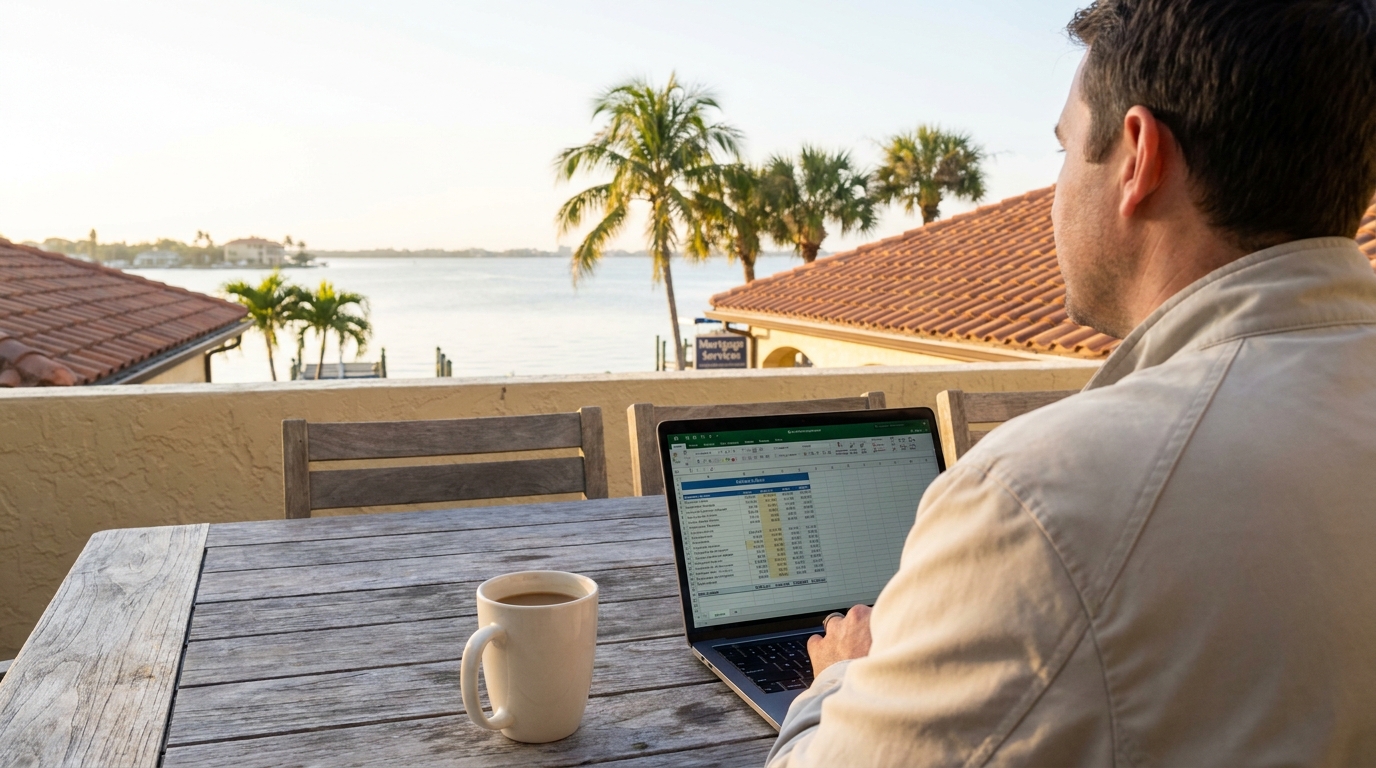
If you've been watching mortgage rates and wondering whether it's finally time to refinance your Clearwater home, you're not alone. Rates have moved, home values across Pinellas County have shifted, and a lot of homeowners are trying to figure out whether the math actually works for them right now.
The honest answer is: it depends on your current rate, how long you plan to stay, and what your closing costs look like. Let's walk through how to think about it.
Where Clearwater Refinance Rates Stand in Mid-2026
As of mid-June 2026, the Florida statewide average for a 30-year fixed refinance sits around 6.63%, with the 15-year fixed near 5.96%. Jumbo refinances are averaging about 6.75% for loan amounts above the conforming limit. The Freddie Mac PMMS benchmark came in at roughly 6.52% as of June 11, 2026.
There's no separate rate index just for Clearwater. Tampa Bay metro borrowers typically price within a few tenths of a percent of those statewide averages. The good news: lender competition across Pinellas and Hillsborough counties tends to be healthy, which can yield slightly tighter pricing than smaller rural Florida markets.
A quick note on the other common products: 5/6 ARM refinances are running around 6.25% on the introductory side, FHA streamline refinances near 6.4%, VA IRRRLs around 6.2%, and cash-out 30-year fixed refinances closer to 6.9%. These are approximations — exact pricing depends on the lender, the day, and your file.
The Break-Even Question (This Is the Whole Game)
Refinancing isn't free. Closing costs in the Clearwater market typically run 2% to 6% of the loan amount, and you only come out ahead if you stay in the home long enough for your monthly savings to outrun those upfront costs.
The formula is simple, and it's the one the CFPB recommends:
Break-even months = Total closing costs ÷ Monthly principal & interest savings
So if your refinance costs $8,000 and you save $250 a month, your break-even is 32 months — about two years and eight months. Stay longer than that, and the refinance pays off. Move or refinance again before then, and you've lost money.
For most Clearwater homeowners we see, break-even lands somewhere in the 2-to-5 year range, depending on how big the rate drop is and how much you're financing.
When Refinancing Probably Makes Sense
- You can drop your rate by roughly 0.75% to 1% or more. Smaller drops can still work, but they extend the break-even timeline.
- You plan to stay in the home past your break-even point. If you're in a long-term home in Belleair, Countryside, or near Clearwater Beach and not planning to move, the math gets a lot friendlier.
- You want to drop mortgage insurance. If your home value has climbed enough that you're now under 80% LTV, refinancing out of FHA mortgage insurance can save real money even without a dramatic rate change.
- You want to switch from an ARM to a fixed rate. If your adjustable period is ending and you'd rather lock in certainty, that's a legitimate reason to refinance even at a similar rate.
- You need to tap equity. Cash-out refinances price higher (around 6.9% currently), but for home improvements — including the wind mitigation and roof upgrades that affect Florida homeowners insurance — it can still pencil out.
When It Probably Doesn't
- You're planning to sell within a couple of years. The closing costs likely won't be recovered in time.
- The rate drop is small (under half a point) and your closing costs are average or higher.
- You'd be restarting a 30-year clock late in your existing loan, adding years of interest that wipe out the monthly savings.
- Your credit or LTV has moved against you since your original loan, meaning your quoted rate won't be as competitive as the published average.
Clearwater-Specific Factors Worth Weighing
A few local realities affect the refinance decision here in ways they don't in other markets.
Insurance costs. Florida homeowners insurance and wind coverage have been volatile, and lenders escrow for them. If your insurance premium has jumped, your total monthly payment may not drop as much as the rate alone would suggest. Run the numbers on the full PITI, not just principal and interest.
Flood zones. Much of coastal Clearwater — particularly Island Estates, Sand Key, and parts of downtown near the Intracoastal — sits in FEMA flood zones. A refinance can trigger a new flood determination, and if your zone designation has changed, that could affect required coverage.
Hurricane season timing. Closing a refinance during peak hurricane season (roughly August through October) sometimes runs into insurance binding restrictions when a named storm is in the Gulf. If you're aiming to close in late summer, build in a little buffer.
Snowbird and second-home pricing. If your Clearwater property is a second home or investment property rather than a primary residence, expect rate add-ons of roughly 0.25% to 0.75% above the owner-occupied figures quoted above.
Should You Use a Mortgage Broker or Go Direct to a Lender?
This is one of the most common questions we hear, and the answer depends on what you value.
Going direct to a single bank or credit union is straightforward — one application, one underwriter, one set of disclosures. The tradeoff is that you only see that institution's pricing and product menu.
A mortgage broker shops your file across multiple wholesale lenders, which can surface better pricing or product fit, especially for borrowers with anything non-vanilla in their file: self-employment income, jumbo loan sizes, recent credit events, or investment properties. Brokers also handle the paperwork on your behalf and can compare Loan Estimates side by side.
For Clearwater homeowners who want someone local who understands Tampa Bay property nuances — flood zones, insurance escrows, condo lending requirements on the beach — working with a local broker like Bay to Bay Lending often produces a cleaner experience than calling an 800 number.
How to Actually Compare Offers
The CFPB recommends getting at least three competing Loan Estimates. The Loan Estimate is a standardized form, which makes apples-to-apples comparison much easier than it used to be. Focus on:
- The interest rate and APR
- Total closing costs (Section E + the lender fees in Section A)
- Whether discount points are baked in (1 point = 1% of loan amount, paid upfront to lower the rate)
- Whether lender credits are offsetting costs (effectively a "no-cost" refi at a slightly higher rate)
- The monthly payment, including escrow
Then run the break-even on each one.
FAQs
What credit score do I need to refinance in Clearwater?
Most conventional refinances want a 620 minimum, with the best pricing typically at 740+. FHA and VA programs are more flexible. Your exact rate offer depends on the full file, not just the score.
How long does a refinance take in the Tampa Bay area?
Typical timelines run 30 to 45 days from application to closing, though streamlined programs (FHA Streamline, VA IRRRL) can move faster because documentation requirements are reduced.
Can I refinance if my home value dropped?
Possibly. FHA Streamline and VA IRRRL programs often don't require a new appraisal. A traditional rate-and-term refinance does, and a lower appraised value can affect your LTV and pricing.
Are rates expected to drop further in 2026?
Nobody knows. Rates are tied to economic data, Fed policy, and bond markets that move daily. The right time to refinance is when the math works for your specific situation — not when you've successfully timed the bottom.
The Bottom Line
Refinancing in Clearwater right now makes sense for some homeowners and not for others. The deciding factors are your current rate versus today's roughly 6.63% benchmark, your closing costs, and how long you plan to stay. Run the break-even, get at least three Loan Estimates, and look at total monthly cost — not just the rate.
Homeowners in Clearwater who want a local read on whether refinancing actually pencils out for their specific situation can reach Bay to Bay Lending at https://baytobaylending.com/ for a no-obligation review of the numbers.